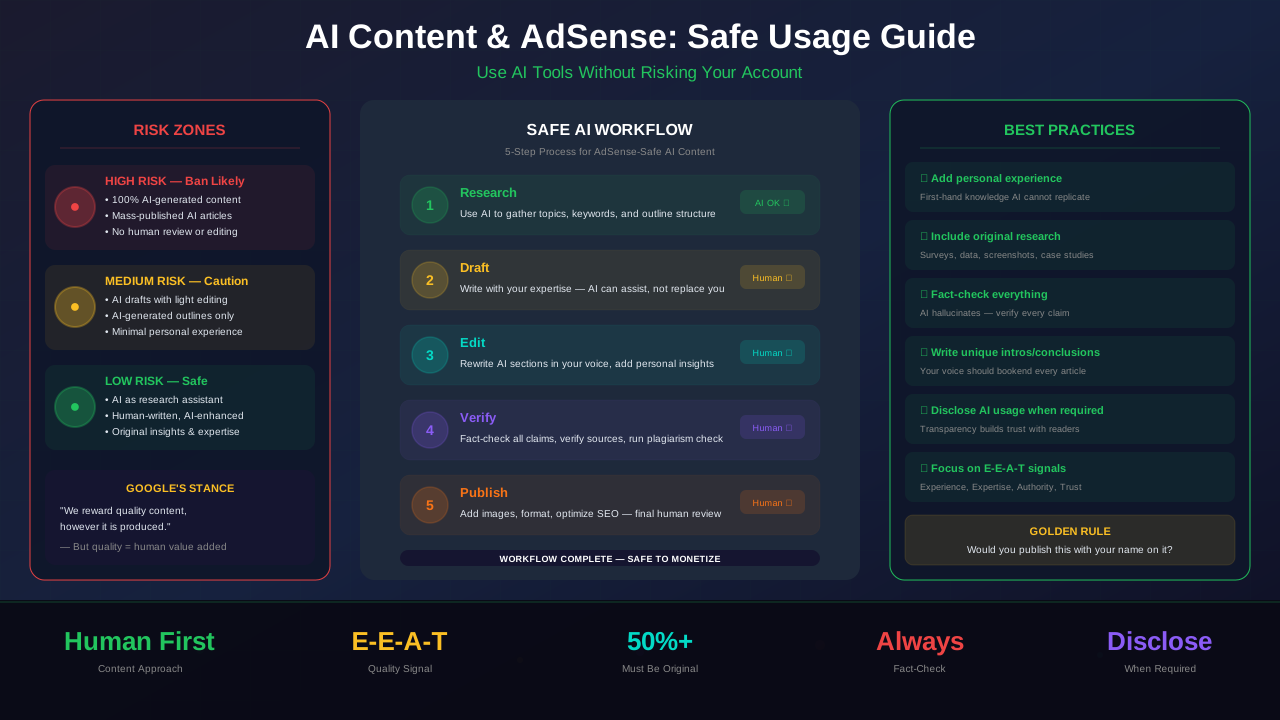
AI writing tools like ChatGPT, Claude, and Gemini have transformed content creation, but for AdSense publishers the stakes are high. One wrong move — publishing mass-generated, low-quality AI content — can trigger a policy violation, slash your ad revenue, or get your account permanently banned. The good news? Google doesn't ban AI content outright. It bans low-quality content, regardless of how it was produced. This guide shows you exactly how to use AI as a powerful writing assistant while keeping your AdSense account safe and your content genuinely valuable.
Google's Official Stance on AI-Generated Content
Google's position on AI content has evolved significantly. In early 2023, Google updated its Search guidelines to clarify that AI-generated content is not inherently against its policies. The key distinction Google makes is between content created for people versus content created to manipulate search rankings.
Here's what Google has explicitly stated:
- AI content is allowed — Google does not penalize content simply because AI was involved in its creation.
- Quality is what matters — Content must demonstrate expertise, experience, authoritativeness, and trustworthiness (E-E-A-T).
- Spam policies still apply — Using AI to mass-produce content designed to manipulate rankings is a violation.
- Helpful content is rewarded — The Helpful Content System evaluates whether content provides genuine value to readers.
"Our focus on the quality of content, rather than how content is produced, is a useful guide that has helped us deliver reliable, high-quality results to users for years."
— Google Search Central, Guidance about AI-generated content (February 2023)
For AdSense publishers, this means you can absolutely use AI tools in your workflow. But there's a critical nuance: AdSense has its own set of content quality policies that go beyond basic search guidelines. AdSense specifically requires that your site provides original, valuable content and a good user experience. Thin, repetitive, or auto-generated content that adds no value is grounds for account rejection or suspension.
What Makes AI Content Risky for AdSense Accounts
Not all AI usage is equal. There's a spectrum from safe, human-guided AI assistance to dangerous, fully automated content farms. Understanding where the risks lie helps you stay on the right side of Google's policies.
The Red Flags That Trigger AdSense Violations
- Mass-published AI content with no editing — Publishing dozens of articles per day with raw AI output is the fastest route to a ban.
- Generic, surface-level content — AI tends to produce "Wikipedia-style" content that restates common knowledge without adding depth.
- Factual inaccuracies — AI models hallucinate facts, cite non-existent studies, and fabricate statistics. Publishing these errors destroys trust.
- Repetitive phrasing patterns — Unedited AI content often uses the same transitional phrases, structures, and filler language across articles.
- Missing personal experience — Google's E-E-A-T framework includes "Experience" — something AI fundamentally cannot provide.
- Thin content with no original value — If your AI content doesn't say anything a reader couldn't find in the first five search results, it's low-value content.
Real Consequences: What Happens When You Get Flagged
AdSense violations related to content quality can escalate quickly:
- Ad serving limited — Google restricts the number of ads shown on your site, cutting revenue dramatically.
- Policy violation warning — You receive a notification in your AdSense dashboard with a deadline to fix issues.
- Site-level enforcement — Your entire domain may be demonetized, not just individual pages.
- Account suspension — Repeated violations can lead to permanent account closure with no appeal.
The financial impact is severe. Publishers who've been banned report losing anywhere from a few hundred to tens of thousands of dollars per month in recurring revenue — income that's nearly impossible to recover since Google rarely reinstates suspended accounts.
How to Use AI Tools as Writing Assistants (Not Replacements)
The key mental shift is this: AI should be your writing assistant, not your writer. Think of AI tools as a very fast, very knowledgeable intern — they can draft, research, and organize, but they need your expertise, judgment, and voice to produce something publishable.
What AI Does Well
- Outlining and structure — Ask AI to create a detailed outline based on your topic and target keywords.
- First drafts — Use AI to generate rough drafts that you then rewrite substantially.
- Research summaries — Have AI summarize complex topics so you can understand them quickly before writing your own take.
- Headline variations — Generate dozens of headline options to test for CTR.
- Rephrasing and clarity — Use AI to simplify technical language or suggest alternative phrasings.
- SEO suggestions — AI can help identify related keywords, LSI terms, and search intent variations.
- Editing and proofreading — Tools like Grammarly and ChatGPT can catch grammar issues and improve readability.
What AI Does Poorly
- Original opinions — AI produces safe, middle-of-the-road takes that lack a distinctive voice.
- Personal anecdotes — It cannot share what it hasn't experienced.
- Current information — AI training data has cutoff dates; it may present outdated information as current fact.
- Nuanced analysis — AI often misses industry context, cultural nuance, and practical considerations.
- Accurate statistics — AI frequently fabricates or misattributes data, studies, and quotes.
A practical workflow is to let AI handle the 40% of writing that's structural (outlining, organizing, formatting) while you handle the 60% that's substantive (insights, experience, analysis, fact-checking). This approach aligns perfectly with what Google wants: high-value, people-first content that demonstrates real expertise.
Human Editing and Fact-Checking Requirements
Editing AI content isn't just about fixing typos — it requires a systematic approach to transform generic AI output into authoritative, trustworthy content that satisfies both readers and Google's quality guidelines.
For more on this topic, see our guide on Blog Traffic Growth Strategies: 12 Proven Ways to Get More Readers in 2026 →
The Five-Layer Editing Process
Layer 1: Fact Verification
Every statistic, claim, date, and reference produced by AI must be independently verified. AI models confidently present fabricated information — a phenomenon known as "hallucination." Before publishing:
- Verify every statistic against primary sources
- Check that cited studies actually exist
- Confirm dates, names, and technical details
- Remove any claims you cannot verify
Layer 2: Voice and Tone
Raw AI content sounds generic. Your editing should inject your brand's unique voice. Replace AI's formal, committee-written tone with your authentic style — whether that's conversational, authoritative, witty, or technical.
Layer 3: Original Insights
This is the layer that separates safe AI usage from risky AI usage. For every major section, ask yourself: "What can I add that AI couldn't?" This includes:
- Your personal experience with the topic
- Lessons learned from real projects
- Industry observations from your professional network
- Contrarian perspectives or nuanced opinions
- Original data from your own experiments or surveys
Layer 4: Structural Improvement
AI often produces content in predictable patterns. Break these patterns by:
- Reorganizing sections for better flow
- Adding unexpected analogies or examples
- Varying paragraph lengths and sentence structures
- Inserting relevant visuals, tables, or diagrams
Layer 5: Quality Assurance
Final check against AdSense quality requirements: Is the content comprehensive? Does it answer the searcher's question better than competing pages? Would you be proud to put your name on it?
Adding E-E-A-T Signals to AI-Assisted Content
Google's E-E-A-T framework (Experience, Expertise, Authoritativeness, Trustworthiness) is your roadmap for making AI-assisted content safe and competitive. Here's how to strengthen each signal:
Experience
This is the signal AI simply cannot fake. Demonstrate first-hand experience by:
- Including screenshots from your own projects, dashboards, or tools
- Sharing specific results with real numbers: "When I implemented this strategy on my cooking blog, organic traffic increased 47% over three months"
- Describing challenges you personally encountered and how you solved them
- Adding photos of products you've actually tested or places you've actually visited
Expertise
Show depth of knowledge beyond what a general AI prompt would produce:
Learn more in SEO Content Writing Guide: How to Write Articles That Rank and Convert →
- Include technical details that require subject-matter knowledge
- Reference industry-specific concepts correctly, with proper context
- Provide step-by-step guidance based on proven methodologies
- Link to authoritative external sources that support your points
Authoritativeness
Build authority through consistent, high-quality output:
- Maintain a detailed author bio page with credentials
- Build a topical cluster of related articles that demonstrate depth in your niche
- Earn backlinks from reputable sites in your industry
- Be cited by other content creators as a reliable source
Trustworthiness
Build trust through transparency and accuracy:
- Clearly attribute sources and data
- Include dates on all content and update outdated information
- Display clear contact information and about pages
- If using AI assistance, consider disclosing it (more on this below)
"The helpful content system aims to better reward content where visitors feel they've had a satisfying experience, while content that doesn't meet a visitor's expectations won't perform as well."
— Google Search Central, Understanding the Helpful Content System
AI Content Detection and How Google Evaluates Quality
There's widespread anxiety about AI detection tools, but the reality is more nuanced than most publishers realize.
AI Detection Tools: The Truth
Tools like Originality.ai, GPTZero, and Copyleaks claim to detect AI-generated content, but they have significant limitations:
- High false-positive rates — Human-written content is frequently flagged as AI, especially formal or academic writing.
- Easy to circumvent — Light editing often changes detection results dramatically.
- Inconsistent results — The same content can get different scores on different tools or even on the same tool at different times.
Google does not use third-party AI detection tools to evaluate content. Instead, Google evaluates content quality through a combination of:
- Helpfulness signals — Does the content satisfy user search intent? Do users engage with it or bounce quickly?
- Quality raters — Human evaluators assess content using the E-E-A-T framework and published quality guidelines.
- Algorithmic assessment — Machine learning models evaluate content depth, originality, and value relative to existing search results.
- Spam detection — Separate systems identify patterns consistent with mass-produced, manipulative content.
What This Means for You
Don't obsess over "passing" AI detection tools. Instead, focus on creating content that would score well with a human quality rater. Ask yourself: If an expert in this topic read my article, would they consider it helpful, accurate, and insightful? That's the standard Google is working toward, regardless of whether AI was involved in the creation process.
Safe Workflows for AI-Assisted Content Creation
Here's a battle-tested workflow that maximizes AI efficiency while keeping your content safe for AdSense monetization. This process has been refined through publishing hundreds of articles across multiple monetized sites.
For more on this topic, see our guide on Content Localization Strategy: Reach Global Audiences & Boost Revenue →
Prompt Engineering for Better AI Drafts
The quality of your AI output depends heavily on your prompts. Instead of generic requests like "Write a blog post about keyword research," use detailed prompts that set constraints and expectations:
- Specify tone and audience — "Write for intermediate bloggers who have 6-12 months of experience with AdSense."
- Include your outline — Give the AI your detailed outline with bullet points of what each section should cover.
- Request specific formats — "Include a comparison table, a step-by-step process, and three real-world examples."
- Set constraints — "Don't use filler phrases like 'in today's digital landscape' or 'it's important to note.'"
- Provide context — Share your unique perspective or data so the AI can weave it into the draft.
The Section-by-Section Approach
Rather than asking AI to write an entire article at once, generate one section at a time. This gives you more control, produces higher-quality output, and makes it easier to inject your own expertise into each section. For each section:
- Provide the section heading and key points from your outline
- Include any personal experiences or data to incorporate
- Generate the draft for that section
- Immediately edit, rewrite, and enhance before moving to the next section
Content That AI Cannot Replace
Understanding what AI fundamentally cannot produce helps you identify your competitive advantage as a human creator. These are the elements that make your content stand out and keep your AdSense account safe:
Case Studies
Detailed case studies from your own experience or your clients' experiences are gold for both readers and search engines. An AI can write a generic case study template, but it can't tell the story of how you personally grew a site from 0 to 50,000 monthly visitors, the specific mistakes you made along the way, and the exact strategies that worked.
Personal Experience and Testing
When you test a tool, implement a strategy, or try a new approach, your first-hand account is inherently valuable. Readers trust content that says "I tried this for 90 days, and here's what happened" far more than generic "Top 10 tips" articles that AI churns out. This is the core of the "Experience" component in E-E-A-T.
Original Research and Data
Surveys, experiments, data analysis, and industry reports based on original data are impossible for AI to replicate. If you analyze your own site's AdSense performance data and share the findings, that content is unique in the truest sense. This type of content naturally attracts backlinks and social shares, further strengthening your site's authority.
Expert Interviews and Community Insights
Conversations with industry experts, insights from professional communities, and aggregated wisdom from your network provide perspectives that AI training data may not include — especially for recent developments or niche topics.
Contextual Analysis and Predictions
Analyzing industry trends, connecting dots across multiple developments, and making informed predictions based on experience requires human judgment that AI lacks. When Google's algorithm shifts, your informed analysis of how it affects AdSense publishers specifically is far more valuable than AI's generic explanation of the update.
Learn more in Featured Snippets Optimization: Boost Traffic and Revenue Fast →
Building your evergreen content strategy around these human-only elements ensures long-term traffic and monetization stability that pure AI content cannot achieve.
Best Practices for AI Content Disclosure
The question of whether to disclose AI usage in your content is both an ethical and strategic consideration. Here's a balanced approach:
When Disclosure Is Recommended
- YMYL content — If your content covers health, finance, legal, or safety topics, transparency about AI involvement builds trust.
- Product reviews — Readers expect reviews to come from actual experience. If AI helped write portions, be upfront.
- Regulated industries — Some jurisdictions and industries are developing disclosure requirements for AI-generated content.
- Client work — If you create content for others, your agreement should address AI usage.
How to Disclose Effectively
If you choose to disclose, keep it simple and honest. A brief note in your editorial policy or at the end of articles works well:
"Our content is created by human writers and editors who use AI tools to assist with research, drafting, and editing. All content is fact-checked, reviewed, and reflects our genuine expertise and experience."
This type of disclosure actually builds trust rather than undermining it. It shows readers you have a rigorous editorial process while being transparent about your tools.
AdSense and Disclosure
Google's AdSense program does not currently require disclosure of AI usage. However, Google does require that your content provides genuine value and complies with their publisher policies. Disclosure of AI usage will not protect you if the underlying content is low-quality — and conversely, high-quality AI-assisted content doesn't need disclosure to stay compliant. Focus on quality first, disclosure second.
Common Mistakes to Avoid
After reviewing hundreds of sites that have faced AdSense issues related to AI content, these are the most common mistakes publishers make:
Mistake 1: Prioritizing Quantity Over Quality
The temptation to "scale content" with AI is real. Some publishers go from 4 articles per month to 40, thinking more content equals more revenue. In practice, Google's algorithms are sophisticated enough to identify sites that suddenly flood the index with mediocre content. A well-planned content strategy with 8-12 high-quality articles per month will outperform 40 thin ones every time.
For more on this topic, see our guide on How to Find Trending Topics & Create Viral Blog Content →
Mistake 2: Not Adding Unique Value
The most dangerous form of AI content isn't obviously bad — it's content that's "good enough" but not differentiated. If your article covers the same points in the same way as every other article on page one, AI or not, it doesn't deserve to rank. Always ask: "What does my article offer that readers can't get anywhere else?"
Mistake 3: Ignoring Fact-Checking
AI hallucinations can destroy your credibility and your site's trustworthiness signal. One fabricated statistic or non-existent study citation can undermine an otherwise excellent article. Build fact-checking into your workflow as a non-negotiable step.
Mistake 4: Using the Same AI Template for Every Article
When you use the same prompt structure for every article, AI produces content with recognizable patterns — similar introductions, identical transition phrases, and predictable structures. Vary your approach, prompts, and editing style to keep content fresh and natural.
Mistake 5: Skipping the Final Read-Through
Always read your finished article from start to finish before publishing. Read it aloud if possible. AI-generated phrases that look fine when scanning often sound robotic and stilted when read naturally. If something sounds like it was written by a committee, rewrite it in your own voice.
Frequently Asked Questions
Can I use ChatGPT or Claude to write articles for my AdSense site?
Yes, you can use AI writing tools for your AdSense site, but you should not publish raw AI output. Use these tools as assistants — for brainstorming, outlining, drafting, and editing. The key requirement is that the final published content must be substantially edited by a human, include original insights and experience, and provide genuine value to readers. Content that is purely AI-generated with no human editing or added value risks violating AdSense quality policies.
Will Google ban my AdSense account for using AI content?
Google will not ban your account simply for using AI in your content creation process. Google has explicitly stated that AI-generated content is not against its policies. However, Google will take action against low-quality content regardless of how it was produced. If your AI content is thin, inaccurate, repetitive, or doesn't provide unique value, it could trigger content quality violations. The determining factor is quality, not the tool used to create it.
How much should I edit AI-generated content before publishing?
A good benchmark is to rewrite or substantially modify at least 50-70% of any AI-generated draft. This isn't about reaching a specific percentage — it's about ensuring the final content reflects your expertise, voice, and unique insights. At minimum, you should verify all facts, add personal experience or original analysis, rewrite generic passages in your own voice, and ensure the content offers something readers can't find elsewhere.
Do I need to disclose that I used AI to write my blog posts?
Google's AdSense program does not currently require disclosure of AI usage. However, transparency can build reader trust, especially for YMYL (Your Money, Your Life) content. If you use AI as an assistant while adding substantial human value, a brief note in your editorial policy is sufficient. More important than disclosure is ensuring the content itself is high-quality, accurate, and genuinely helpful.
Can Google detect AI-generated content?
Google has not confirmed using specific AI detection technology in its ranking algorithms. Instead, Google evaluates content quality through its Helpful Content System, spam detection algorithms, and human quality raters. Third-party AI detection tools are unreliable with high false-positive rates. Rather than trying to "fool" detectors, focus on creating content that a human expert would rate as helpful, accurate, and valuable — that's the standard Google actually applies.
What types of content should I NOT use AI for?
Avoid relying on AI for content that requires personal experience (product reviews, case studies), original research or data analysis, medical or legal advice, content about very recent events, and anything where accuracy is critical and difficult to verify. For these content types, AI can help with structure and editing, but the core substance must come from a qualified human with direct knowledge of the subject.
How many AI-assisted articles per month is safe for AdSense?
There is no specific number that Google considers safe or unsafe. What matters is the quality of each individual article, not the quantity or the tools used. A site publishing 30 well-edited, high-value AI-assisted articles per month is safer than a site publishing 5 raw, unedited AI articles. That said, a sudden dramatic increase in publishing volume can trigger algorithmic scrutiny, so scale gradually and maintain consistent quality standards.