A well-crafted disclaimer page protects both you and your readers whilst satisfying Google's transparency requirements. Many publishers overlook this essential legal page, but a proper disclaimer demonstrates professionalism, limits liability, and contributes to the trustworthiness signals that AdSense reviewers evaluate.
This guide provides ready-to-use disclaimer templates along with explanations of why each element matters for AdSense publishers specifically.
Why Disclaimers Matter for AdSense Publishers
Disclaimers serve multiple purposes that directly impact your AdSense success:
Legal Protection
Disclaimers limit your liability when readers act on your content. If you provide advice, reviews, or educational content, a disclaimer clarifies that readers are responsible for their own decisions.
Trust and Transparency
Google values transparency. Clear disclaimers about your relationships with advertisers, affiliate programmes, and sponsors demonstrate honest communication with your audience—a quality AdSense reviewers appreciate.
FTC Compliance
If you recommend products or services, the FTC Endorsement Guides require disclosure of material relationships. A comprehensive disclaimer helps satisfy these requirements. For detailed FTC guidance, see our complete guide on affiliate disclosure and FTC requirements.
Professional Credibility
Proper legal pages signal that you run a legitimate operation, not a fly-by-night website. This professionalism influences both human reviewers and reader trust.
AdSense Connection
While disclaimers are not explicitly required by AdSense, they contribute to the overall quality and trustworthiness of your site. Publishers with complete legal pages typically experience smoother approval processes and fewer policy concerns.
Types of Disclaimers for Publishers
Different content types require different disclaimers. Here are the main categories:
Complete Disclaimer Page Template
Below is a comprehensive disclaimer template you can customise for your website. Copy the relevant sections and modify the bracketed text with your specific information:
For more on this topic, see our guide on Terms & Conditions Generator Guide: Protect Your Blog Legally in 2026 →
Disclaimer
Last updated: [Date]
General Information
The information contained on [Your Website Name] (the "Website") is for general information purposes only. [Your Website Name] assumes no responsibility for errors or omissions in the contents of the Website.
In no event shall [Your Website Name] be liable for any special, direct, indirect, consequential, or incidental damages or any damages whatsoever, whether in an action of contract, negligence or other tort, arising out of or in connection with the use of the Website or the contents of the Website. [Your Website Name] reserves the right to make additions, deletions, or modifications to the contents on the Website at any time without prior notice.
Not Professional Advice
The Website cannot and does not contain [financial/medical/legal] advice. The [financial/medical/legal] information is provided for general informational and educational purposes only and is not a substitute for professional advice. Accordingly, before taking any actions based upon such information, we encourage you to consult with the appropriate professionals. We do not provide any kind of [financial/medical/legal] advice.
THE USE OR RELIANCE OF ANY INFORMATION CONTAINED ON THE WEBSITE IS SOLELY AT YOUR OWN RISK.
Advertising Disclosure
This Website displays advertisements through Google AdSense and may contain advertisements from other advertising networks. These advertisements are served by third parties and may use cookies and web beacons to collect information (not including your name, address, email address, or telephone number) about your visits to this and other websites in order to provide relevant advertisements about goods and services of interest to you.
The appearance of third-party advertisements on the Website does not constitute an endorsement, guarantee, or recommendation by [Your Website Name] of the advertiser or the quality of the product or service being advertised.
For more on this topic, see our guide on COPPA Compliance for Bloggers: How to Protect Kids and Your AdSense Account →
Affiliate Disclosure
[Your Website Name] may earn a commission from purchases made through affiliate links on this Website. When you click on these links and make a purchase, we may receive a small commission at no additional cost to you. This helps support the Website and allows us to continue providing free content.
Our affiliate relationships do not influence our editorial content. We only recommend products and services that we believe provide value to our readers.
External Links Disclaimer
The Website may contain links to external websites that are not provided or maintained by or in any way affiliated with [Your Website Name]. Please note that [Your Website Name] does not guarantee the accuracy, relevance, timeliness, or completeness of any information on these external websites.
Testimonials Disclaimer
The Website may contain testimonials by users of our products and/or services. These testimonials reflect the real-life experiences and opinions of such users. However, the experiences are personal to those particular users, and may not necessarily be representative of all users of our products and/or services. We do not claim, and you should not assume, that all users will have the same experiences.
Fair Use Disclaimer
This Website may contain copyrighted material, the use of which may not have been specifically authorised by the copyright owner. This material is available in an effort to explain issues relevant to [your niche/topic]. The material contained in this Website is distributed without profit for research and educational purposes only.
"Use at Your Own Risk" Disclaimer
All information in the Website is provided "as is", with no guarantee of completeness, accuracy, timeliness or of the results obtained from the use of this information, and without warranty of any kind, express or implied, including, but not limited to warranties of performance, merchantability and fitness for a particular purpose.
Contact Us
If you have any questions about this Disclaimer, please contact us at [your contact email].
For more on this topic, see our guide on Image Attribution & Copyright: The Complete Blogger Guide →
Customising Your Disclaimer
The template above covers most scenarios, but you should customise it based on your specific content:
For Finance/Investment Content
Add stronger language clarifying that your content is educational only and not investment advice. Include statements that readers should consult licensed financial advisors before making investment decisions.
For Health/Medical Content
Clearly state that content is informational only and not medical advice. Readers should consult healthcare professionals for medical decisions. Consider adding that you are not a licensed medical professional (if applicable).
For Product Reviews
Explain your review methodology and that opinions are your own. Disclose if you received products for free and clarify that free products do not guarantee positive reviews.
For User-Generated Content
If your site allows comments or user submissions, add language stating you are not responsible for user-generated content and reserve the right to remove inappropriate content.
Placement and Accessibility
Your disclaimer page should be easily accessible:
Essential Placement
- Footer Links: Include a link in your website footer alongside Privacy Policy and Terms
- About Page Reference: Mention and link to the disclaimer from your About page
- Navigation Menu: Consider including in secondary navigation or legal section
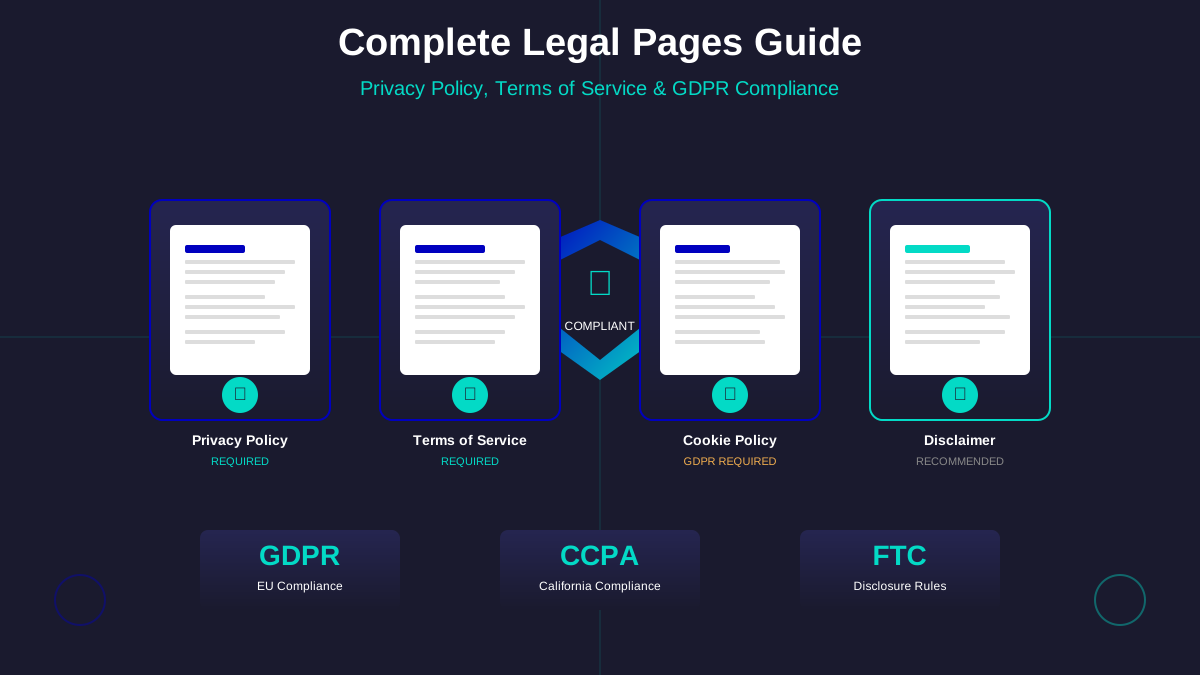
Your disclaimer should be part of a complete set of legal pages. Ensure you also have a compliant privacy policy and terms of service linked in your footer.
Related reading: Copyright Laws for Bloggers: How to Use Images Legally →
In-Content Disclosures
Beyond your dedicated disclaimer page, include specific disclosures within content:
- Affiliate links should have disclosure near the link or at the article top
- Sponsored content should be clearly labelled
- Product reviews should disclose if products were received free
FTC Disclosure Tip
The FTC requires affiliate disclosures to be "clear and conspicuous." A link to your disclaimer page is not sufficient for individual affiliate links. Include brief disclosure text near affiliate links (e.g., "This post contains affiliate links. See our Disclaimer for details."). For AdSense compliance, also review Google's Program Policies.
Industry-Specific Considerations
YMYL Content (Your Money or Your Life)
If your content covers finance, health, legal, or safety topics, Google holds you to higher standards. Your disclaimer should:
- Explicitly state you are not providing professional advice
- Recommend consulting qualified professionals
- Include your credentials (or lack thereof) transparently
- Reference authoritative sources for important claims
E-Commerce and Product Sites
If you sell products or recommend purchases:
- Disclose all affiliate relationships
- Explain your product selection process
- Include satisfaction guarantees or return policies
- Address pricing accuracy and potential changes
Legal Requirements by Region
Different jurisdictions have varying disclosure requirements:
United States (FTC)
The Federal Trade Commission requires clear disclosure of material connections between endorsers and advertisers. This includes affiliate relationships, free products, and paid partnerships.
European Union (Consumer Rights Directive)
EU regulations require clear identification of commercial content and trader information. Combine your disclaimer with proper cookie consent and GDPR compliance.
See also: Sponsored Content Disclosure: Legal Requirements Every Blogger Must Know →
United Kingdom (CAP Code)
The UK's Advertising Standards Authority requires clear labelling of advertising content. Affiliate content should be marked as such.
Maintaining Your Disclaimer
Your disclaimer is not a create-and-forget document:
- Update Date: Change the "Last updated" date whenever you make modifications
- Annual Review: Review your disclaimer annually to ensure continued accuracy
- New Partnerships: Update when you add new affiliate programmes or advertising networks
- Content Changes: If you expand into new content types, update relevant sections
- Legal Changes: Monitor for regulatory changes that might require updates
Frequently Asked Questions
Do I need a lawyer to create my disclaimer?
For most small publishers, a well-crafted template like the one provided is sufficient. You can also use reputable generators like Termly or Iubenda as starting points. However, if your content covers high-risk topics (financial advice, medical information, legal guidance) or you generate significant revenue, consulting a lawyer familiar with digital media is advisable.
Can I just copy another website's disclaimer?
Copying verbatim is not recommended as disclaimers should be tailored to your specific content and relationships. Additionally, some disclaimer language may be copyrighted. Use templates as starting points and customise for your situation.
Where should I place my disclaimer on each page?
A dedicated disclaimer page linked from your footer is standard. For affiliate content, brief in-line disclosures near affiliate links are required in addition to your main disclaimer page.
Does having a disclaimer guarantee legal protection?
Disclaimers provide a layer of protection but are not absolute shields. Courts consider the reasonableness and visibility of disclaimers. The best protection combines clear disclaimers with honest, accurate content.
Should I include my disclaimer in multiple languages?
If you target audiences in multiple language regions, providing translated disclaimers demonstrates thoroughness. At minimum, provide the disclaimer in the primary language of your content.
Conclusion: Building Trust Through Transparency
A comprehensive disclaimer page demonstrates professionalism and protects both you and your readers. For AdSense publishers specifically, proper legal pages contribute to the trust signals that Google evaluates during approval and ongoing reviews.
Take time to customise the template provided to accurately reflect your website's content, relationships, and business model. Update it regularly as your site evolves, and always maintain transparency in your disclosures.
Remember: the goal is not just legal protection, but building genuine trust with your audience. Readers who trust your transparency are more likely to engage with your content and return to your site—ultimately benefiting both your audience and your AdSense revenue.