
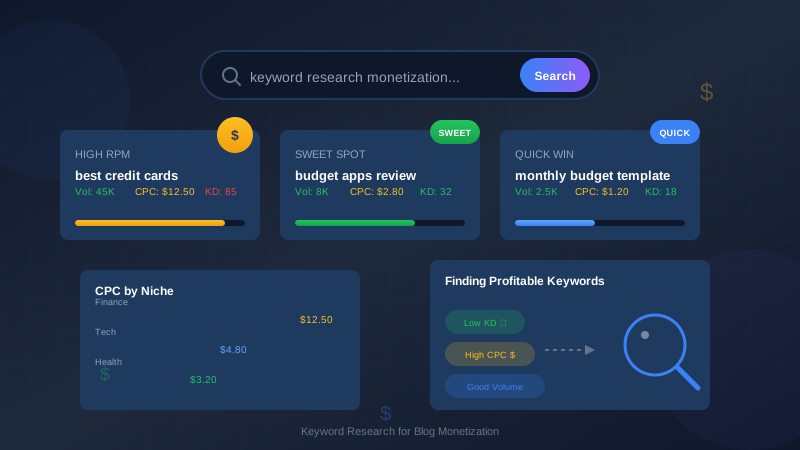
The topics you write about directly impact how much money you earn. Some keywords attract advertisers willing to pay $50+ per click. Others barely bring in pennies. Keyword research is how you find the difference.
Smart bloggers do not just write about what interests them. They research which topics can generate real revenue while still providing value to readers. This guide shows you exactly how to find those profitable keywords.
What You Will Learn:
- Why keyword choice impacts AdSense earnings
- How to identify high-RPM keywords
- Step-by-step keyword research process
- Best free and paid research tools
- How to build a profitable content calendar
Why Keywords Matter for Monetization
Every keyword has a different advertising value. When someone searches for "best credit cards for travel," advertisers pay premium rates because that person might apply for a card. When someone searches for "funny cat videos," advertisers pay much less.
The Economics of Keywords
Google AdSense works on an auction system. Advertisers bid on keywords they want to target. The more competition, the higher the bids. Your RPM depends largely on what topics you cover.
| Keyword Category | Typical CPC Range | Competition Level | Revenue Potential |
|---|---|---|---|
| Finance & Insurance | $3.00 - $50.00 | Very High | Excellent |
| Legal Services | $5.00 - $75.00 | Very High | Excellent |
| Health & Medical | $1.00 - $15.00 | High | Very Good |
| Technology & Software | $0.80 - $8.00 | High | Good |
| Education | $1.00 - $12.00 | Medium-High | Good |
| Home & Garden | $0.50 - $4.00 | Medium | Moderate |
| Entertainment | $0.10 - $1.00 | Low-Medium | Low-Moderate |
"Choose your niche based on what you can write about sustainably, but let keyword research guide your specific topics within that niche."
— Content Monetization Strategy
Beyond CPC: The Traffic Factor
High CPC means nothing without traffic. A keyword paying $50 per click is worthless if only 10 people search for it monthly. The sweet spot combines:
- Decent search volume: Enough people searching to drive traffic
- Good CPC: Advertisers willing to pay for those searches
- Manageable competition: A realistic chance to rank
- Clear intent: Visitors who will engage with content and ads
Understanding High-RPM Keywords
RPM (Revenue Per Mille) measures how much you earn per 1,000 pageviews. High-RPM keywords share common characteristics.
Commercial Intent Signals
Keywords with buying intent attract higher-paying ads. Look for words like:
- "Best" (best laptops, best insurance)
- "Compare" (compare mortgages)
- "Review" (software reviews)
- "Price" or "cost" (cost of solar panels)
- "Buy" or "purchase"
- "Discount" or "deal"
- "vs" comparisons (iPhone vs Samsung)
High-Value Niches Within Any Topic
Even in low-paying niches, you can find profitable sub-topics. Here is an example for a parenting blog:
| Low RPM Topics | Higher RPM Alternatives |
|---|---|
| Fun activities for kids | Best educational toys by age |
| Cute baby photos | Baby gear reviews and comparisons |
| Parenting stories | Life insurance for new parents |
| Holiday crafts | Budgeting apps for families |
| Bedtime routines | Best baby monitors reviewed |
Evergreen vs Trending Keywords
Evergreen keywords provide consistent traffic year-round. Trending keywords spike quickly but fade. For sustainable monetization, focus 80% on evergreen content.
- Evergreen example: "How to start a budget" - Always relevant
- Trending example: "Black Friday deals 2026" - Short spike
Learn more about timing content in our seasonal content strategy guide.
The Keyword Research Process
Follow this systematic process to find profitable keywords for your blog:
For more on this topic, see our guide on Blog Traffic Growth Strategies: 12 Proven Ways to Get More Readers in 2026 →
Step 1: Define Your Core Topics
Start with 3-5 broad topics related to your niche. These become your "seed" topics.
Example for a personal finance blog:
- Budgeting
- Saving money
- Investing basics
- Debt payoff
- Side income
Step 2: Expand with Keyword Tools
Use keyword research tools to find related terms. For each seed topic, generate 50-100 keyword ideas.
Seed Topic: "Budgeting"

Expanded Keywords:
- budgeting for beginners
- how to create a budget
- 50/30/20 budget rule
- best budgeting apps
- monthly budget template
- zero-based budgeting
- budget categories
- emergency fund budget
- budgeting mistakes to avoid
- budgeting tips for low income
Step 3: Analyze Search Metrics
For each keyword, gather these data points:
| Metric | What It Tells You | Ideal Range |
|---|---|---|
| Monthly search volume | How many people search | 500 - 50,000 |
| Keyword difficulty (KD) | How hard to rank | Under 40 for new sites |
| CPC estimate | Advertiser value | $0.50+ minimum |
| Competition | How many sites target it | Low to medium |
| Trend direction | Growing or declining | Stable or growing |
Step 4: Evaluate SERP Competition
Search each keyword in Google. Look at the top 10 results and ask:
- Are they from major authority sites or smaller blogs?
- How comprehensive is their content?
- Can you create something better?
- Are there any low-quality results you could replace?
Step 5: Calculate Potential Value
Estimate the potential monthly revenue for each keyword:
Potential Revenue Formula:
Monthly Searches × CTR × RPM ÷ 1000

Example: "Best budgeting apps"
- Monthly searches: 12,000
- Expected CTR: 3% (360 visitors)
- Estimated RPM: $15

Potential: 360 × $15 ÷ 1000 = $5.40/month

For one article, not bad! Now multiply across 50 articles...
Step 6: Create Your Keyword Shortlist
Score each keyword based on all factors. Prioritize those with the best combination of volume, competition, and revenue potential.
"I would rather rank #1 for 50 medium-volume keywords than struggle to rank for 5 highly competitive ones."
— Successful Blog Monetization
Free Tools for Keyword Research
You do not need expensive tools to do effective keyword research. These free options work well:
Learn more in SEO Content Writing Guide: How to Write Articles That Rank and Convert →
Google Keyword Planner
Google's own tool provides search volume ranges and CPC estimates. You need a Google Ads account but do not need to run ads.
- Best for: CPC data, search volume ranges
- Limitation: Volume ranges, not exact numbers
Google Search Console
Shows what keywords already bring traffic to your site. Often reveals opportunities you did not know existed.
- Best for: Finding existing keyword opportunities
- Limitation: Only shows your own data
Google Trends
Reveals whether keywords are growing or declining. Compare multiple keywords to find the best opportunities.
- Best for: Trend analysis, seasonal patterns
- Limitation: No absolute numbers
Answer The Public
Generates question-based keywords. Shows what people actually ask about your topic.
- Best for: FAQ content, long-tail keywords
- Limitation: Limited free searches daily
Ubersuggest (Free Tier)
Neil Patel's tool offers limited free searches with good data. Provides keyword difficulty scores.
- Best for: Quick keyword checks
- Limitation: 3 searches per day free
Also Asked
Pulls "People Also Ask" data from Google. Great for finding related questions to answer.
- Best for: Related questions, content ideas
- Limitation: Limited free uses
| Tool | Volume Data | CPC Data | Difficulty Score | Best Use Case |
|---|---|---|---|---|
| Keyword Planner | Ranges | Yes | Competition only | CPC research |
| Search Console | Yes | No | No | Existing opportunities |
| Google Trends | Relative | No | No | Trend analysis |
| Answer The Public | No | No | No | Question keywords |
| Ubersuggest | Yes | Yes | Yes | All-around research |
Premium Tools Worth the Investment
Once you are serious about monetization, these paid tools provide deeper insights:
Ahrefs ($99+/month)
Industry-leading for backlink and keyword data. The Keywords Explorer provides extremely accurate metrics.
- Strengths: Accurate data, competitor analysis, content gap feature
- Best for: Serious content marketers
Semrush ($120+/month)
Comprehensive SEO suite with excellent keyword research. Shows keyword difficulty and SERP features.
For more on this topic, see our guide on Content Localization Strategy: Reach Global Audiences & Boost Revenue →
- Strengths: Keyword magic tool, competitor keywords, topic research
- Best for: Full SEO workflow
Moz Pro ($99+/month)
Solid keyword research with good difficulty scores. Strong community and educational resources.
- Strengths: SERP analysis, link data, easy interface
- Best for: SEO beginners to intermediate
KWFinder ($49+/month)
Affordable option focused specifically on keyword research. User-friendly interface for finding low-competition keywords.
- Strengths: Easy to use, affordable, good difficulty metric
- Best for: Budget-conscious bloggers
Is Paid Worth It?
If your blog earns over $500/month from ads, investing in a paid tool usually pays for itself. Start with free tools, upgrade when you are earning enough to justify the cost.
"I started with free tools until my blog hit $800/month. Then I invested in Ahrefs, and my earnings doubled within 6 months because I found better keywords."
— Monetized Blogger
Evaluating Keyword Profitability
Not every keyword with good metrics is worth targeting. Evaluate each opportunity carefully.
The Profitability Score System
Rate each keyword from 1-5 on these factors:
| Factor | Weight | What to Consider |
|---|---|---|
| Search Volume | 20% | Is there enough traffic potential? |
| CPC Value | 25% | How much do advertisers pay? |
| Competition | 25% | Can you realistically rank? |
| Intent Match | 15% | Will visitors engage? |
| Content Fit | 15% | Does it match your expertise? |
Red Flags to Avoid
- Dominated by brands: If top 10 is all Amazon, Wikipedia, major brands
- Highly volatile: Traffic swings wildly month to month
- YMYL without credentials: Health/finance without expertise
- Declining trend: Search interest dropping year over year
- Mismatch: Keyword does not fit your site's focus
Green Flags to Pursue
- Forums ranking: Reddit, Quora in top 10 means opportunity
- Outdated content: Old articles ranking means you can update
- Thin results: Current results do not fully answer the query
- Growing interest: Upward trend in Google Trends
- Commercial intent: Keywords with buying signals
Building a Content Plan
Turn your keyword research into an actionable content calendar.
Organize Keywords by Clusters
Group related keywords together. Each cluster becomes a content pillar with supporting articles.
Cluster: "Budgeting"

Pillar Article:
- "Complete Guide to Creating a Budget" (2500+ words)

Supporting Articles:
- "50/30/20 Budget Rule Explained"
- "Best Budgeting Apps Compared"
- "Monthly Budget Template (Free Download)"
- "How to Budget on Irregular Income"
- "Budgeting Mistakes That Cost Money"
- "Zero-Based Budgeting for Beginners"
Prioritization Framework
Schedule content based on potential impact:
Related reading: AI Content and AdSense: How to Use AI Safely Without Getting Banned →
- Quick wins: Low competition, decent volume - write these first
- Growth drivers: Higher competition, high value - invest time
- Long-term plays: Very competitive, very valuable - build up to these
- Fill-ins: Low volume, low competition - publish when time allows
Sample Content Calendar
| Week | Priority | Keyword Target | Content Type |
|---|---|---|---|
| 1 | Quick Win | "budgeting app comparison" | Listicle |
| 2 | Growth | "how to create a budget" | Pillar Guide |
| 3 | Quick Win | "monthly budget template" | Resource Post |
| 4 | Fill-in | "envelope budgeting method" | How-to |
| 5 | Growth | "best credit cards beginners" | Review Post |
Balancing Revenue and Traffic
Mix high-RPM and high-traffic keywords. High-RPM keywords often have lower volume, while popular topics may have lower ad rates.
- 60% moderate volume + moderate RPM: Your bread and butter
- 25% high volume + lower RPM: Traffic builders
- 15% low volume + high RPM: Revenue boosters
Learn more about structuring content in our pillar content strategy guide.
Common Keyword Research Mistakes
Avoid these errors that hurt monetization potential:
Mistake 1: Chasing Only High Volume
High volume keywords are usually very competitive. New sites cannot rank for them. Target realistic keywords you can actually win.
Mistake 2: Ignoring Search Intent
If someone searches "free budget template," they want free content. Showing them ads for paid software creates a bad experience and low engagement.
Mistake 3: Keyword Stuffing
Google penalizes content that unnaturally forces keywords. Write for humans first, optimize naturally.
Mistake 4: One Keyword Per Article
Every article should target a primary keyword plus 3-5 related terms. This expands your ranking potential without additional effort.
Mistake 5: No Topic Clustering
Random articles on unrelated topics look unfocused. Build clusters of related content to establish topical authority.
Mistake 6: Forgetting to Update Research
Keywords change over time. What worked last year might not work now. Review and update your keyword strategy quarterly.
Learn more in Featured Snippets Optimization: Boost Traffic and Revenue Fast →
Mistake 7: Only Targeting Informational Keywords
Informational content ("what is budgeting") attracts visitors but often has low RPM. Balance with commercial intent keywords ("best budgeting apps").
"Your keyword research is never finished. The best monetized blogs constantly refine their strategy based on performance data."
— Content Monetization Best Practices
Putting It All Together
Keyword research is the foundation of profitable blogging. Get it right, and you set yourself up for consistent AdSense revenue. Here is your action plan:
- Today: List 5 seed topics in your niche
- This week: Use free tools to expand each into 20+ keywords
- Next week: Analyze metrics and shortlist top 30 keywords
- This month: Create your first content cluster
- Ongoing: Track rankings and refine your strategy
Remember: The goal is not just traffic—it is profitable traffic. Focus on keywords that bring visitors who will engage with your content and ads.
Want to learn more about content optimization? Check out our guide on structuring posts for higher ad viewability.
Frequently Asked Questions
How many keywords should I target per article?
Focus on one primary keyword and 3-5 secondary keywords per article. The primary keyword should appear in your title, URL, and first paragraph. Secondary keywords should appear naturally throughout the content. Do not force keywords—write naturally and include them where they fit.
What is a good CPC to target for AdSense?
Any keyword with a CPC above $0.50 is worth considering. Keywords between $1-5 are the sweet spot for most bloggers—valuable enough for good RPM but not so competitive that ranking is impossible. Above $5 CPC usually means fierce competition from established sites.
How often should I do keyword research?
Do a comprehensive research session quarterly to find new opportunities. Monthly, check your Search Console for emerging keywords you already rank for. Weekly, track rankings for your target keywords to spot trends.
Should I target keywords with zero search volume?
Sometimes yes. Zero-volume keywords in tools often still get searches—tools just cannot detect them. If a keyword has clear intent and low competition, it can be worth targeting. Many successful bloggers rank for dozens of "zero volume" keywords that collectively bring significant traffic.
How do I compete with big sites for valuable keywords?
Target long-tail variations. Instead of "best credit cards" (dominated by major sites), try "best credit cards for college students with no credit history." Longer, more specific keywords have less competition and often convert better because they match specific user needs.